


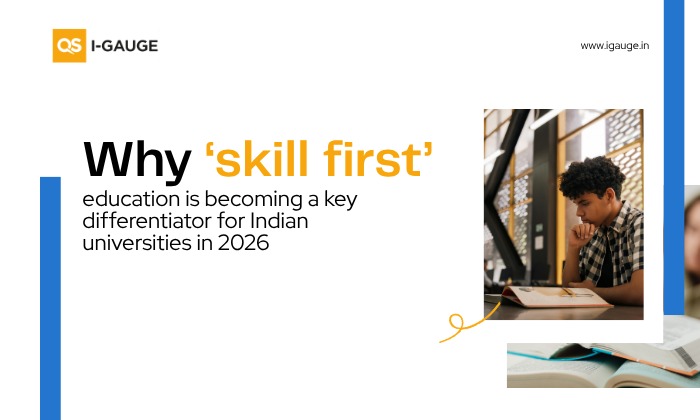
‘Employability’ as a concept has been redefined in the current age. Top recruiters hire for skills, not just scores and degrees. Skill-based education is a predominant approach that universities should steadily adapt to and focus on practical and real-world abilities.
What is employability?
Employability indicates the capability of a candidate to get a job, sustain it, and grow in their career. Generally speaking, fetching a job is the primary step, but employability is a broader term that encompasses -
a. Possessing the right skills. This is a combination of technical skills, i.e., job-specific abilities, and soft skills such as communication, emotional intelligence, teamwork, problem-solving, and critical thinking mindset, time management, etc.
b. Internships and real-world experience.
c. The right attitude, i.e., an open mind to learn, and receive feedback and criticism.
d. Adaptability and willingness to learn to stay valuable at work.
What makes a graduate employable in 2026?
In the current dynamic job market, employers look for candidates who possess all these qualities together with real-world AI skills, proficiency with digital tools, exposure to data and data analytics, and sustainable skills. The India Skills Report of 2026 indicates an increase in the employability percentage to 56.35%, which is powered by a balanced combination of theory and practice.
It is seen that traditional degrees do not equip students to fully take up the jobs with all the necessary skills, leading to a higher degree of unemployment. Employers today carefully assess the job-ready skills and future-ready talent, and the potential of a candidate, more than their degrees/qualifications.
Artificial Intelligence, cybersecurity, cloud computing, and data science are considered core capabilities in modern organisations across sectors.
Factors that have driven this demand –
1. Every business is rapidly digitising its operations.
2. Today, every analysis and decision-making is powered by AI.
3. With easy access to digital platforms, cyberattacks are on the rise. Studies show that by 2030, India will need about 1 million cybersecurity professionals, but are we prepared to meet the demands of the future if we do not focus on skill-based learning?
How can universities step up to the plate?
It is seen that fewer than 20% colleges and universities can place about 75% of students within 6 months of graduation. Only 8.9% of institutions have their curriculum aligned with industry demands.
Redesigning the curriculum around skills is the need of the hour. Graduates should pass out of the college knowing what they can do rather than just knowing what they have studied. Institutions should focus on mapping every course to specific, clear, and measurable outcomes. Modules should focus on actionable outcomes, thereby building specific skills. Analytical thinking and decision-making abilities should be integrated into the teaching methods through real-life scenarios.
For instance, Master’s Union School of Business is an autonomous, new-age business school that provides mentorship to students by industry practioners including CEOs, founders, and other management-level executives, and an opportunity to focus on practical business application rather than traditional academics.
Through progressive skill development exercises and processes, institutions can build depth and confidence in students.
Focus on industry collaborations. The tech, CRM, and analytical tools used in actual workplaces need to be integrated into the study ecosystem. Institutions should co-create programs with industry leaders to develop job-relevant competencies throughout. Tie-ups with the top healthcare, tech, hospitality, financial services, and other sectors can bridge the gap between classrooms and the workplace.
Focus on employability skills. All employability skills, including technical, soft, self-management, digital, and AI skills, as well as transferable skills, need to be addressed as part of the curriculum so that students are job-ready upon graduation.
Train the trainers. Faculty need to be trained to act more like facilitators who can enable learning, facilitate problem-solving and critical thinking, guide discussions, and mentor students on projects. Upskilling of teaching faculty in digital tools and platforms is another necessity. Proficiency in collaboration and presentation tools, learning platforms (LMS), and industry-relevant software can help them translate their knowledge into classroom settings and workplace environments. Faculty should also be trained on experiential learning methods through case-based teaching and problem-based learning frameworks.
Multidisciplinary learning is a pressing need as real-world problems are not just about one domain. Combining fields such as healthcare and AI, business and data analytics, psychology and marketing, etc., can help provide solutions to many real-world issues. Instead of rigid streams, universities should bring about skill combinations to prepare graduates for hybrid skill sets. This can be facilitated through collaborative projects and cross-functional thinking between domains.
Measure success differently. Success should be based on assessing the skill proficiency levels, employability rates, i.e., quality of roles, not just placement rates, and tracking the career growth in 3 to 5 years. These serve as real KPIs for understanding how students are thriving in the real world.
Integrate technology for adaptive learning. An AI-enabled ecosystem can offer continuous, personalised, and on-demand learning. Also, AI can connect learning directly to career outcomes, track real-time progress, provide real-time insights, and suggest improvement plans for an AI-driven future.
In 2026, universities that adapt quickly to the skill-first model through NEP mandates are bound to attract more students and funding. This approach can also tackle IT sector slowdowns by focusing on broader career opportunities and essential skills.
In conclusion, skill-first education is redefining how universities prepare students for the future. Universities that prioritise employable skills produce graduates who are not just qualified but are capable in the true sense and future-ready.


-1.png)


.svg)

.svg)
.svg)