


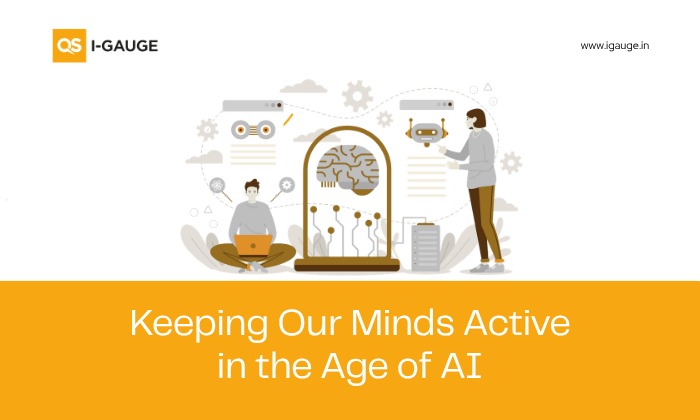
In this era of AI, the rapid adoption of artificial intelligence in education brings both opportunities and challenges. While AI tools make learning, research, and content creation easier, smoother, and more accessible, heavy reliance on them can reduce opportunities to practice critical thinking, evaluation, analytical reasoning, problem-solving, and independent conclusion-drawing.
A relatively new term for this process, where technology is used to perform mental tasks which would otherwise be done by humans, is called ‘Cognitive offloading’. This is a fundamental challenge for both educators and learners to find the right balance, i.e., using AI to support learning while largely engaging the mind to think, question, evaluate, and create content.
The goal for students in this AI-enabled world is not to do away with technology but to use it consciously. Here are practical ways to stay mentally engaged and keep developing critical thinking skills while staying in touch with technology.
1. Try the Human-First 30-Minute Rule
Before prompting an AI tool for an assignment or project, spend the first 30 minutes using your cognitive abilities to map ideas, sketch a basic structure, and outline the key arguments and challenges. This enhances the potential of the brain to think and evaluate as the first step and keeps you actively involved in the thinking and learning process.
Once you think critically about the problem, you can ask AI to evaluate it or refine the question if you have trouble understanding it, and help you draw inferences. This technique helps preserve your thinking abilities rather than letting AI do the thinking for you.
2. Practice Active Verification
We have seen instances where AI makes mistakes or provides information you cannot fully rely on. Therefore, treat AI-generated content as a starting point and verify it against credible sources. Check important facts from sources such as research papers, prescribed academic books, trusted databases and websites.
This method not only improves accuracy but also strengthens your understanding of concepts and facts.
3. Embrace Productive Struggle
Learning is not always an easy process. It is imperative to take time and work through challenging ideas and concepts, which can greatly improve the ability to comprehend and retain ideas in memory. When we give this innate human ability to think, we are essentially surrendering its power to AI.
Deep learning happens when there is friction and the mind is constantly challenged. The human mind appreciates what is termed as ‘desired difficulty’, which it literally feeds on. When we first summarise a complex assignment in our minds and then prompt AI, it helps us remember the concepts deeply and for longer.
Conclusion
The ultimate aim of education is to strengthen how we think, not simply make tasks easier. AI can be used extensively to support administrative work and support with learning; it should not replace thinking, curiosity, and reasoning. Students need to set healthy boundaries, stay actively engaged, and use AI as an active learning partner to help build the skills they need in a competitive world.
Explore more thought-provoking articles on modern student life, evolving career landscapes, and institutional best practices on https://www.igauge.in/articles.


-1.png)


.svg)

.svg)
.svg)