


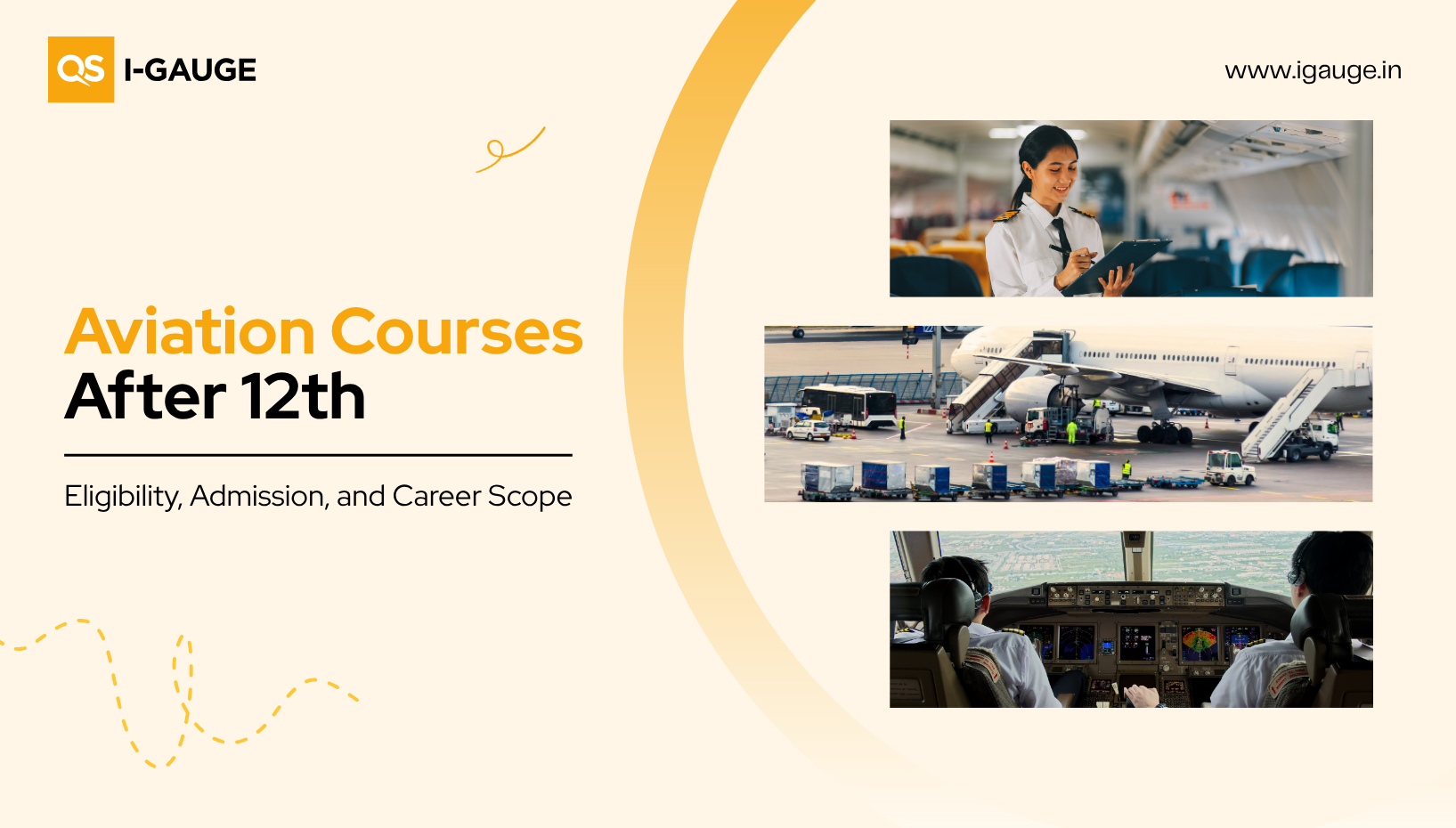
Globally, the aviation industry is one of the fastest-growing sectors. In the Indian context, the rising passenger traffic, expanding airlines, and new airports have increased the demand for skilled aviation professionals. The size of the Indian aviation market is about USD 16.53 billion in 2026 and is expected to grow to USD 28.96 billion by 2031.
Aviation isn’t just about flying the aircraft. The aviation industry needs cabin crew, air traffic controllers, aircraft maintenance engineers, cargo supervisors and specialists, ground staff, airport administration personnel, etc. Depending on their interests and other priorities, students can choose the course that fits the bill.
Popular aviation courses after 12th
1. Bachelor of Business Administration (BBA) in Aviation Management
This is a 3-year undergraduate course. Students after class 12 from any stream (though science and commerce are often preferred), with a minimum aggregate of 50% in qualifying exams such as the Undergraduate Aptitude Test (UGAT), are eligible to apply. Students learn core business principles such as accounting, human resource management, and business economics, along with industry-specific topics such as aviation law, airport planning, air traffic control rules, cargo logistics, etc. The overall program cost ranges from Rs 1 lakh to Rs 9 lakh, depending on the institution.
Some of the common roles after a BBA include airport operations executive, terminal manager, ground handling manager, aviation consultant, and cargo logistics officer. Fresh graduates can earn between Rs. 3 lakhs and Rs. 6 lakhs per annum. Professionals with experience can move into managerial roles with salaries ranging from Rs. 8 lakhs to Rs. 15 lakhs per annum, or higher, depending on expertise and employer.
2. Aerospace Engineering
This is a 4-year undergraduate course. Read the complete course details and career scope here –https://www.igauge.in/blogs/aerospace-engineering-course-details-and-career-scope
3. Commercial Pilot License (CPL) Training
Students after class 12 with physics and mathematics as core subjects and an aggregate of 50% are eligible to apply. Candidates should possess excellent English communication skills and must clear a Class 2 medical exam to start the training and a Class 1 medical exam for the license.
For registration:
1. Candidates should register on the DGCA and eGCA portal and get a unique computer number.
2. Clear the medical tests as the next step.
Training:
1. Join the DGCA-approved flying training organisation and attend classes for about 5-8 months.
2. Only after completing 200 hours of flying, including solo and cross-country flights, and the CPL skill test, will they be granted the license.
Pilot training is quite a finance-heavy investment. The total estimated fees can be between Rs. 50 lakhs and Rs. 1.5 crores or more, depending on whether the candidate trains in India or abroad, whether it is an independent flying school or a structured airline cadet program.
The career pathway includes flying as a first officer or co-pilot, captain, or pilot-in-command after earning the Airline Transport Pilot License (ATPL) with many years of flying experience or in aviation support roles.
4. B.Sc Aviation
This is a 3-year undergraduate degree that focuses on topics such as aerodynamics, aircraft maintenance, and air traffic control. Students after class 12 in the science stream (PCM) with a minimum of 50% are eligible to apply. Admission is merit-based or also through entrance exams such as CUET, AME CET, or certain university-specific tests.
The fee ranges between Rs. 1 lakh and Rs. 6 lakhs, depending on the institution. Graduates can work as aviation safety officers, airport operations executives, flight dispatchers, etc.
5. Aircraft Maintenance Engineering
This is a licensed aviation program that prepares candidates to inspect, maintain, and certify aircraft for flying. Unlike aerospace engineering, which focuses on aircraft design, this program focuses on keeping the aircraft airworthy by constantly checking and monitoring the mechanical and avionics systems.
Students from the science stream (PCM) in class 12 with an aggregate of 45-50% marks are eligible to apply. The course duration is between 2 and 4 years, combining classroom learning with practical exposure in maintenance, repair, and overhaul. Admission is through an entrance test, screening, or interview, followed by a medical test. Admission to a DGCA (Directorate General of Civil Aviation)-approved college is largely based on entrance exams such as AME CEE or institute-specific tests. Fees range between Rs. 3 lakhs and Rs. 8 lakhs for the entire course, depending on the institution.
This is a safety-critical position. After completing the academic and practical training, students should clear the DGCA modular examination to earn the license. They can work as aircraft technicians, maintenance engineers, quality assurance executives, etc.
6. Diploma in Cabin Crew/Air Hostess Training
This is a 6-12-month program open to students after class 12, while some institutes also accept 10th pass candidates. Students from any stream are accepted, with some institutes mandating basic criteria such as good English communication skills, physical standards, and fitness level. The fees vary widely depending on the institution.
Students learn cabin crew roles and responsibilities, emergency procedures, grooming, and personality development. After the program, students can apply for roles such as air host/hostess, cabin crew, ground staff, airport hospitality staff, customer service executives, or travel-related customer roles.
7. Diploma in Ground Staff Services
a. This is a 5-12-month course that covers airport operations, baggage handling, customer service, passenger handling, etc.
b. Students after class 12 from any recognised board with good communication skills, good fitness level, and a presentable personality are eligible to apply. Total fees range between Rs. 65,000 and Rs. 1.5 lakhs for the complete course.
c. After the course, candidates can take up roles in non-flying operational and hospitality segments.
8. Diploma in Air Cargo and Logistics
a. This is a career-focused course, and the duration depends on the institute. It is available as a 3-month, 6- to 8-month, or 1-year course.
b. Students after class 12 from a recognised board with basic communication skills and an aptitude for aviation are eligible to apply. The program costs Rs. 50,000 to Rs. 1.5 lakhs for the entire course, depending on the institute, and educates students on the air cargo industry, cargo acceptance principles, logistics management, documentation, etc.
c. After the program, individuals can work in air cargo departments, freight forwarding companies, airlines, logistics companies, supply chain operations, etc.
9. Diploma in Aviation or Airport Management
a. This is a 6-month to 1-year short-term diploma program. 12th pass students with an aggregate of 50% are eligible to apply, with a fee ranging between Rs. 50,000 and Rs. 2 lakhs for the complete course.
b. The program focuses on airline and airport operations, aviation safety and security, ground handling, customer security, etc. After the program, individuals can work as airport operations executives, ground services officers, passenger services officers, duty terminal staff, etc.
Conclusion
India’s aviation industry is rapidly expanding, opening career paths beyond flying and engineering. It offers opportunities for those interested in travel, communication, logistics, and airport operations and management.
For personalised guidance and more information, write to us at marketing@igauge.in and our team will get in touch with you.
Disclaimer
The blog is curated by referring to various credible sources and does not necessarily reflect the opinions or positions of QS I-GAUGE. The information provided is for general informational purposes only, readers are advised to conduct their own research and seek professional advice before making any decisions.


.png)



.svg)

.svg)
.svg)