


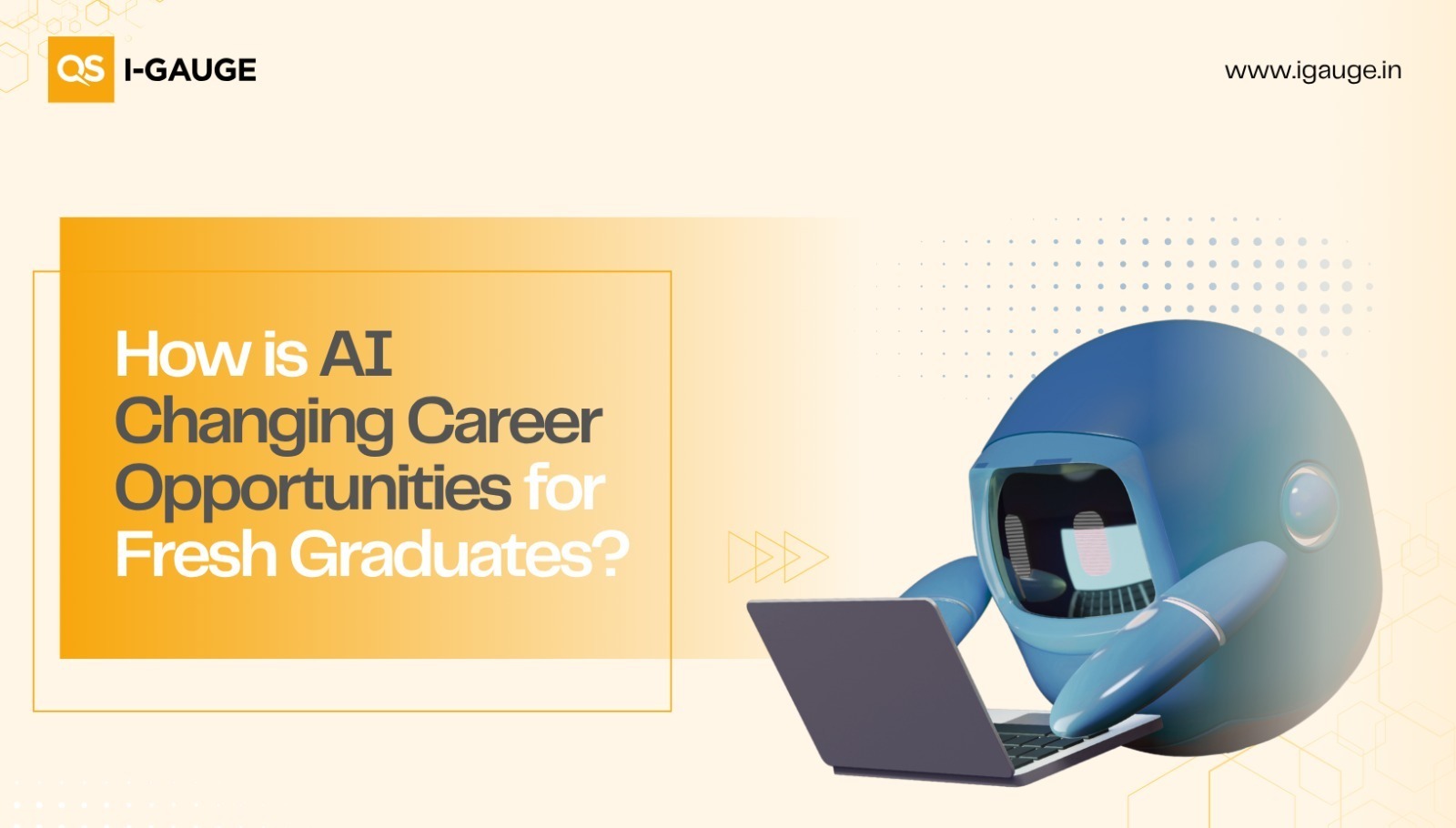
Gone are the days when AI was a futuristic concept. Today, it has become almost as prevalent as the internet itself! Artificial Intelligence is influencing the way we communicate, shop, learn, work, and even travel.
When fresh graduates entered the workforce a few years ago, they were handed tasks such as basic documentation and reporting, first-level content drafting, generic research, routine coding, or administrative support. Now, as AI handles most of these routine tasks with greater efficiency and precision, companies need fewer junior staff and, essentially, expect more from employees!
Indeed, the job portal noted that entry-level vacancies are down by 33% over the past year. Firstpost and the Financial Times have noted that companies are replacing AI-first models for internships and junior roles.
Employers are looking for more than these routine tasks in the people they hire and are slowly shifting their focus towards employees who can perform better problem analysis, communicate more effectively, have stronger decision-making capabilities, adaptability, and judgement, and interpret outputs using AI as a support tool.
Rise of new opportunities and career roles
While it is evident that AI is exerting pressure on certain entry-level roles and that some doors are closing for new entrants, it is also opening new doors! It is creating newer career paths, redefining existing roles, and widening opportunities for graduates from diverse academic backgrounds.
Industries such as engineering, healthcare, retail, transportation, logistics, and cybersecurity are extensively using AI as a support tool rather than a replacement for their human resources. Companies hire graduates who can direct AI and complete tasks with greater precision and speed.
New roles such as AI trainer, prompt engineer, ML specialist, and AI ethics consultant, which were non-existent a decade ago, are among the new job categories created by AI.
How AI is transforming existing jobs
Apart from creating new jobs, AI is also changing how most of the jobs are performed.
For instance,
1. Marketing professionals make use of AI to analyse consumer behaviour, generate campaign ideas and content drafts quickly and with more accuracy.
2. Financial analysts can process large volumes of data more efficiently.
3. Healthcare professionals are using AI for medical diagnostics, patient monitoring, and overall healthcare administration.
4. Factories and manufacturing plants use AI for quality control, predictive maintenance, and operational efficiency.
4. Journalists are making use of AI for better research and data analysis.
5. Educational institutions are combining offline learning with AI-powered personalised learning methodologies to enhance the learning experience and assist educators.
6. Banking and financial institutions are actively using AI systems for risk assessment, fraud detection, and customer service.
7. Media and entertainment have lapped up the AI revolution by using it to create storyboards, production workflows, audience analysis, video edits, lighting and scene composition ideas, music and background score enhancement, and so much more.
Companies today are actively seeking graduates who can build, train, manage, and improve AI models in the workplace. In connection with this, some of the fastest-growing graduate roles in India in 2026 include:
a. AI specialists
b. Generative AI engineers
c. Digital content creators (using AI tools)
d. ML engineers
e. Data analysts
f. AI prompt engineers
h. Human resources and roles in consulting
i. Digital marketing with AI tools
j. Business analysts
k. UI/UX researchers and developers, etc.
It is seen that 11.7% of Indian job postings overtly mention AI skills in their criteria in 2026, up from 8.2% a year ago.
A circular problem for graduates!
Studies show that college students are not very satisfied with how AI is taught in their degree programs and feel a need for a better understanding of AI to succeed. On the other hand, they feel employers are constantly looking for individuals with deep knowledge of AI!
Most employers are now looking for AI-related skills in internships and graduate roles. This means that knowing how to use AI, along with domain knowledge, makes a resume more competitive and gives graduates an edge over others.
The way forward for new entrants
Fresh graduates need to build a mix of domain-specific knowledge and AI skills, and work on enhancing human skills such as empathy, leadership, communication, teamwork, knowledge, adaptability, resilience, emotional intelligence, creativity, and relationship-building.
Where can students start?
1. Online AI courses. Students can also take online certification courses in specialised subjects before landing their first job to gain an edge.
2. Continually explore the latest AI tools relevant to their fields
3. Participate extensively in internships and hands-on projects to get deep domain and industry knowledge. Employers prefer students with related work experience and project-based learning over just good grades.
4. Stay abreast of industry trends and innovations.
Students and graduates who adopt continuous learning win!
Lifelong learners, irrespective of how technologies and innovations evolve, are the ones to succeed. In this AI era, graduates with advanced technical knowledge and good grades are not the ones who win; those who combine technology with critical thinking, communication, creative thinking, and a drive to learn are the ones who excel. The future belongs to those who are ready to adapt and change with the changing times and grow with it.
For personalised guidance and more information, write to us at marketing@igauge.in and our team will get in touch with you.
Disclaimer
The blog is curated by referring to various credible sources and does not necessarily reflect the opinions or positions of QS I-GAUGE. The information provided is for general informational purposes only, readers are advised to conduct their own research and seek professional advice before making any decisions.





.svg)

.svg)
.svg)