


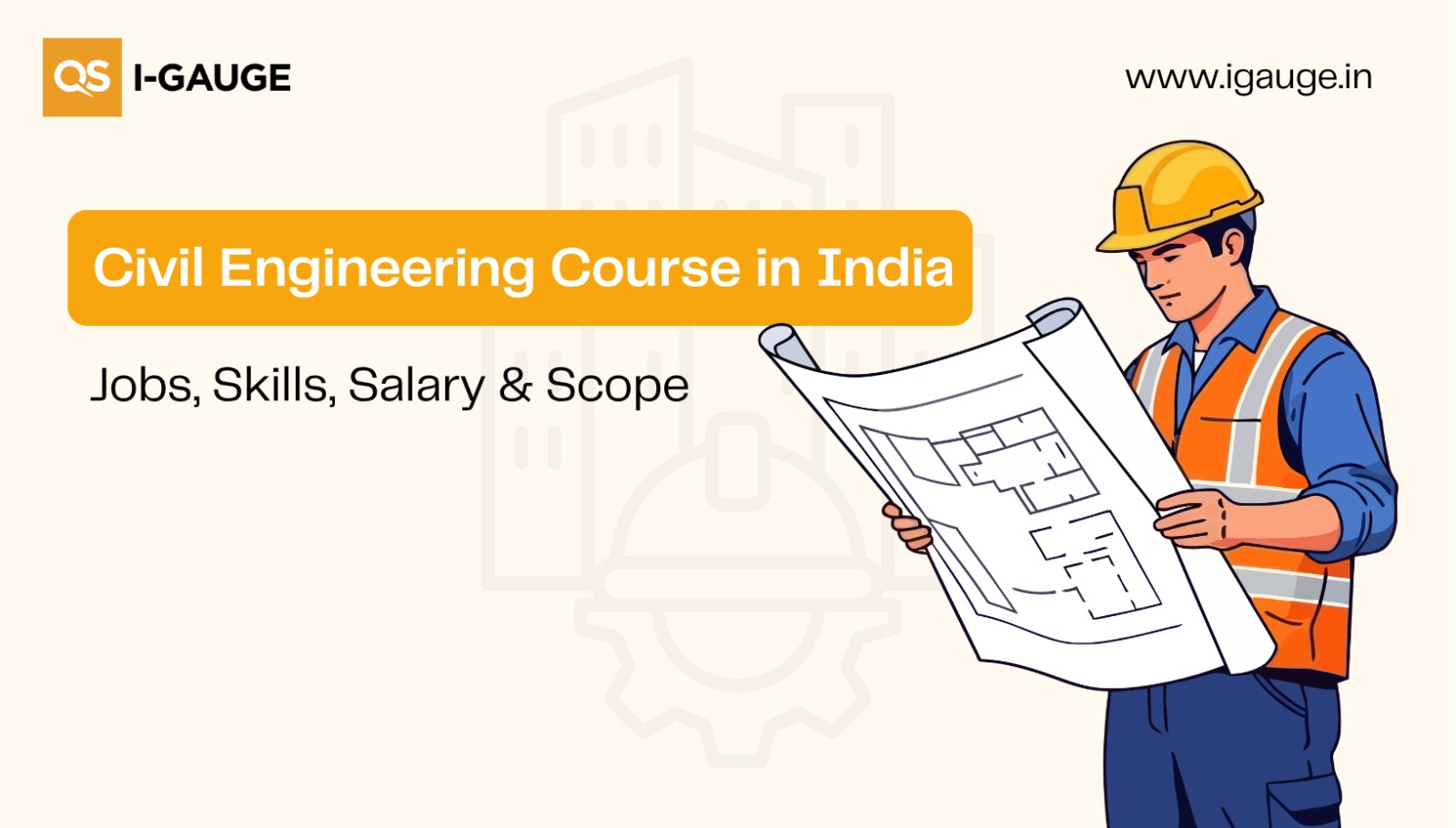
Civil engineering is one of the oldest and most stable courses, supporting modern urban development, including smart city initiatives, the booming real estate and construction sector, and infrastructure projects nationwide. Although technological progress has significantly boosted the construction sector, the human element remains critical to ensure infrastructure is designed, built, and maintained sustainably, meets regulatory and safety standards, and serves community needs.
For students exploring options, understanding the course structure, in-demand skills, job roles, and salary trends can help make an informed decision.
Read about Diploma in Civil Engineering course details and career scope here - https://www.igauge.in/blogs/diploma-in-civil-engineering-in-india-eligibility-admission-process-fees-career-scope
India’s infrastructure pipeline is among the largest globally. The construction and infrastructure sector is expected to grow steadily at around 8.8% annually till 2029, creating long-term career opportunities. Initiatives like metro rail expansion, renewable energy projects, smart city missions, and the national infrastructure pipeline are driving strong demand for civil engineers.
Skills needed for civil engineers in 2026
Civil engineering students should develop a combination of technical knowledge, advanced digital workflows, and human-centric soft skills to stay ahead in 2026.
Technical skills include structural analysis and design, construction management and estimation, site supervision and practical knowledge, quantity surveying and cost estimation, building codes and regulations, surveying and geotechnics, and eco-friendly construction techniques, including knowledge of sustainability and green buildings.
Digital skills include –
· Building Information Modelling (BIM) tools: Mastery of Autodesk Revit and Civil 3D for multidisciplinary 3D intelligent modelling and terrain documentation.
· 4D scheduling and project planning using MS Project, Oracle Primavera P6, etc.
· STAAD.Pro, ETABS, for computational design and structural analysis.
· Digital Twins and Smart infrastructure tools.
· Familiarity with AI/ML applications, and GIS and data analytics workflow tools.
Soft skills include collaborative problem-solving, cross-discipline communication, project management and ownership, adaptability, continuous learning, emotional intelligence, and a team-oriented mindset.
Civil engineers are hired in both public and private sectors.
Public sector: PWD, NHAI, railways, DRDO, ISRO, state electricity boards, municipal corporations, and Public Sector Units (PSUs) such as ONGC and NTPC.
Private sector: EPC companies, real-estate companies, infrastructure consultancies, and construction-tech firms.
Top roles for civil engineering graduates
- Site Engineer/Junior Civil Engineer/Construction Engineer
- Structural Engineer
- Geotechnical Engineer
- Transportation/Highway Engineer
- Quantity Surveyor/Cost Estimator
- Project Engineer/Project Manager
- BIM (Building Information Modelling) Specialist/Coordinator/BIM Engineer
- Civil Data Analyst/Digital Twin Specialist
- Design Engineer (CAD/Computational Design)
- Smart Infrastructure / Urban Planning Analyst
- Environmental Engineer/Water Resources Engineer
- Quality Engineer/Construction Supervisor
- Government/Junior Engineer
Emerging roles with technological integration include BIM Specialist, Digital Construction Manager, and AI-enabled Infrastructure Specialist, showing how the sector is evolving with smart construction and data-driven design.
Certification courses in BIM, project management, or sustainability can significantly enhance employability.
Salary landscape in India
The salaries vary by role, location, company, and skill set.
- Freshers (0–2 years) can earn between Rs. 3 lakhs and Rs. 5.5 lakhs per annum. However, graduates from top-tier institutions or those who secure roles in large enterprises and sectors can earn between Rs. 6 lakhs and Rs. 10 lakhs per annum.
- Mid-level (3–7 years): Mid-career professionals can earn between Rs. 6 lakhs and Rs. 11 lakhs per annum. However, roles such as BIM leads and project managers can earn between Rs. 10 lakhs and Rs. 15 lakhs.
- Senior level (8+ years): Senior civil engineers or project engineers can earn between Rs. 12 lakhs and Rs. 20 lakhs per annum; senior project managers and construction managers with over 12 years of experience can earn between Rs. 15 lakhs and Rs. 45 lakhs per annum. Project Directors overseeing megaprojects can earn up to 50 lakhs per annum.
Specialised roles command higher pay:
- BIM Specialist: Rs. 6 lakhs to Rs. 12 lakhs per annum
- Construction Manager: Rs. 8 lakhs to Rs. 18 lakhs per annum
- Smart Infrastructure/AI-enabled roles: Rs. 8 lakhs to Rs. 20 lakhs
Jobs in the government sector, including PSUs, offer higher stability, allowances, perks, and long-term growth, often similar to or exceeding private-sector packages but mostly at senior levels.
Career Pathways & Higher Studies
After graduation, students can:
- Pursue M.Tech or M.E. through the GATE exam in specialised fields including structural, transportation, geotechnical, or environmental engineering. Through GRE and IELTS/TOEFL, they can pursue an MS at international universities.
- Pursue an MBA or postgraduate diploma in construction technology and management, advanced construction management, infrastructure, or real estate management through CAT/GMAT exams.
- Pursue M.Sc or M.Tech in digital construction, BIM optimisation, environmental and water resource engineering, geoinformatics, or GIS engineering if they are interested in digital infrastructure and sustainable design.
- Appear for SSC JE, state PSCs, ESE for government engineering services.
- Explore research/academia options or start a consultancy/construction venture.
Conclusion
Civil engineering in 2026 offers a strong mix of stability, growth, and societal impact. The professional judgement civil engineers use, along with critical thinking and ethical decision-making to build reliable, long-lasting structures, is something technology cannot replicate. The way forward is to balance technology and AI with human skills in processes. Building the right technical, digital, and soft skills early can help graduates secure better roles and grow their salaries faster.
For personalised guidance and more information, write to us at marketing@igauge.in, and our team will get in touch with you.
Disclaimer
The blog is curated by referring to various credible sources and does not necessarily reflect the opinions or positions of QS I-GAUGE. The information provided is for general informational purposes only, readers are advised to conduct their own research and seek professional advice before making any decisions.






.svg)

.svg)
.svg)