


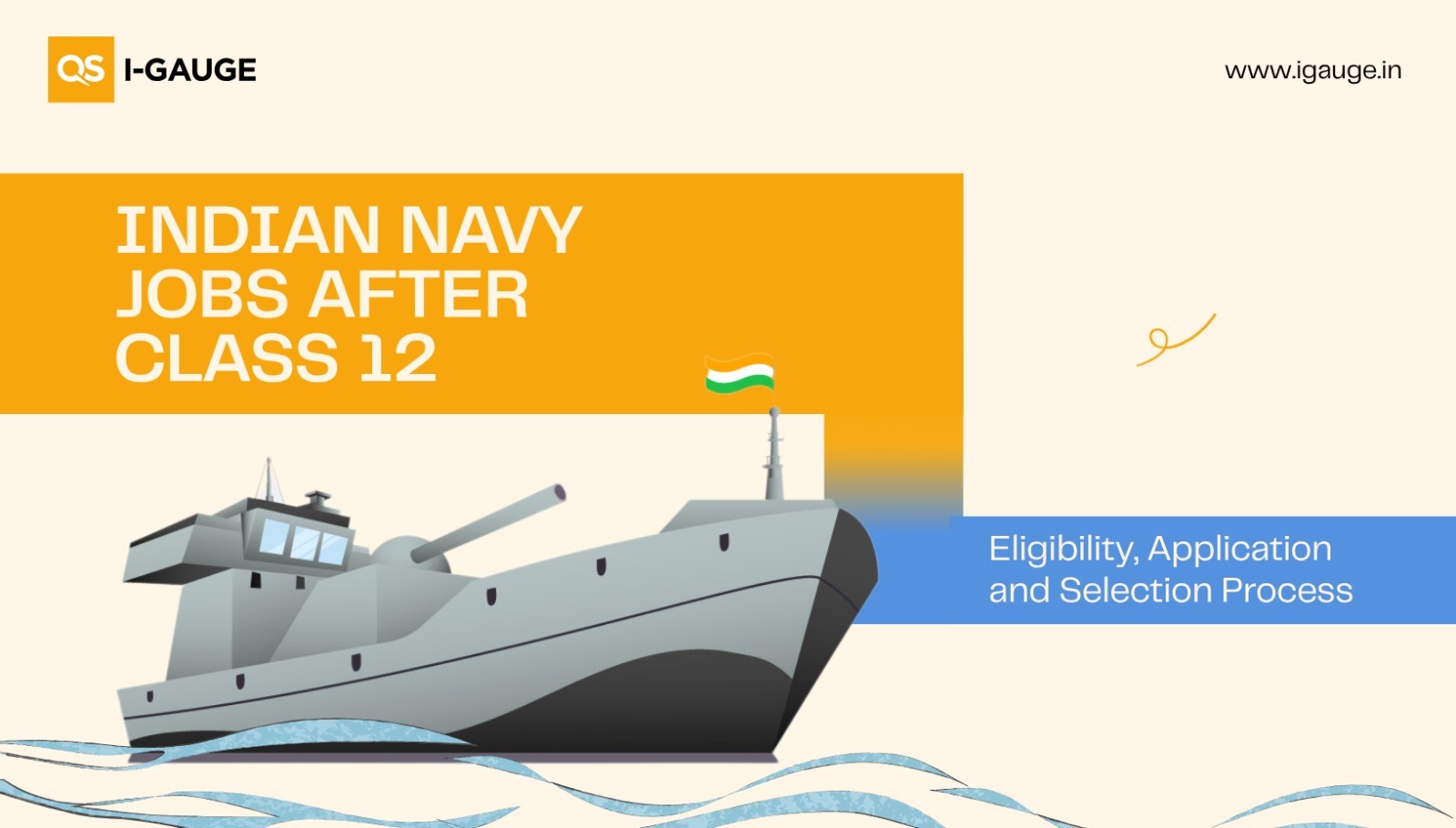
The Indian Navy is one of the key pillars of our defence forces. It is the maritime branch of the Indian Armed Forces that protects our sea borders and trade routes and watches over the nation’s long coastline. It is also instrumental in undertaking humanitarian missions, evacuation operations during disasters, and international treaties and cooperation.
Serving in the navy is more than a defence job. It is a symbol of courage and national pride. It demands discipline, leadership, physical fitness, team spirit, the ability to perform under pressure, and academic excellence. For students looking to serve the nation alongside building a stable and prestigious career, the Indian Navy offers excellent employment opportunities.
Ways to join the Indian Navy after class 12
The Indian Navy offers a wide range of career opportunities and roles in leadership, engineering, navigation, technical operations, logistics, support, and allied functions. These roles offer professional growth, job security, attractive salary packages, and medical facilities.
1. NDA Navy Entry
An entry through the National Defence Academy (NDA) is one of the most prestigious ways to work as an officer in the Navy. Candidates who have cleared Class 12 with a major in physics, chemistry, and mathematics are eligible to apply. Candidates who clear the Services Selection Board (SSB) exam, followed by a medical test, are selected and trained at the National Defence Academy.
Read more about NDA Navy Entry and the career prospects here – https://www.igauge.in/blogs/nda-vs-cds-key-differences-explained.
2. Sailor-level Entries
Agniveer SSR and Agniveer MR are two sailor-level entries in the Indian Navy under the Agnipath scheme.
a. Agniveer SSR
An Agniveer Senior Secondary Recruit (SSR) is meant for students after class 12/equivalent diploma.
• It mandates physics and mathematics along with chemistry/biology/computer science with an aggregate of 50%.
• The age at the time of enrollment should be between 17.5 and 21 years.
• The candidates should be unmarried (male and female), and should pass the fitness test.
• The Agniveers work in technical and operational roles on ships and bases. It is suitable for students with a science background, as it involves equipment, weapon systems, navigation tools, sensors, and communication mechanisms. The role offers practical experience, skill development, and exposure to modern defence technology.
b. Agniveer MR
Agniveer Matric Recruitment (MR) is open to 10th-pass candidates, though students can also apply after clearing class 12. Students after class 10 from a recognised board with 50% aggregate marks are eligible to apply. This mostly offers roles in support functions such as hospitality services and allied duties on board ships and establishments. They will be trained in naval discipline and participate in the Navy's broader operations.
Both SSR and MR follow a similar selection process under the Agnipath scheme.
a. The online application needs to be filled out within the notified dates on the official Navy recruitment portal.
b. Stage 1 – Indian Navy Entrance Test (INET) – This is a computer-based, objective, pattern-based test covering subjects including English, mathematics, science, and general knowledge. The pattern is generally shorter for MR.
C. Stage 2 – Medical and fitness test.
d. Final merit list – After the final list is announced, candidates are enrolled at INS Chilka, the basic training establishment for sailors and Agniveers of the Indian Navy, before being posted to ships and establishments.
Agniveers serve for four years under the Agnipath scheme. After four years, high-performing Agniveers can be chosen for long-term service in the Navy. Others can use their defence experience and savings to transition to government jobs or further studies.
3. 10+2 (B.Tech) Cadet Entry
This is for candidates who have studied Physics, Chemistry, and Mathematics (PCM) in class 12. This is a prestigious path for students to become permanent commissioned officers in the Indian Navy while earning a B.Tech degree from the Indian Naval Academy.
• Candidates should have scored 70% aggregate in PCM and a minimum of 50% in English in class 12. Students are shortlisted depending on their JEE Main scores.
• After the Services Selection Board (SSB) interview and medical test, selected candidates undergo a 4-year B.Tech training at the Indian Naval Academy in core engineering disciplines such as mechanical, electronics and communication, or related areas as per the Navy's requirement.
• After the successful completion of the programme, they are commissioned as officers in the executive and technical branches of the Indian Navy. Commissioned officers are actively exposed to modern warships, submarines, aviation units, and shore establishments.
• The age limit is between 17.5 and 19 years, and they should be unmarried.
For all entries, candidates should satisfy the prescribed nationality, medical, and fitness standards of the Indian Navy.
Conclusion
The Indian Navy offers structured and respected career paths after class 12. Understanding the eligibility, applying on time, proper preparation, and a passion to serve the nation will help build a prestigious career in the Indian Navy.
For personalised guidance and more information, write to us at marketing@igauge.in and our team will get in touch with you.
Disclaimer
The blog is curated by referring to various credible sources and does not necessarily reflect the opinions or positions of QS I-GAUGE. The information provided is for general informational purposes only, readers are advised to conduct their own research and seek professional advice before making any decisions.


.png)



.svg)

.svg)
.svg)