


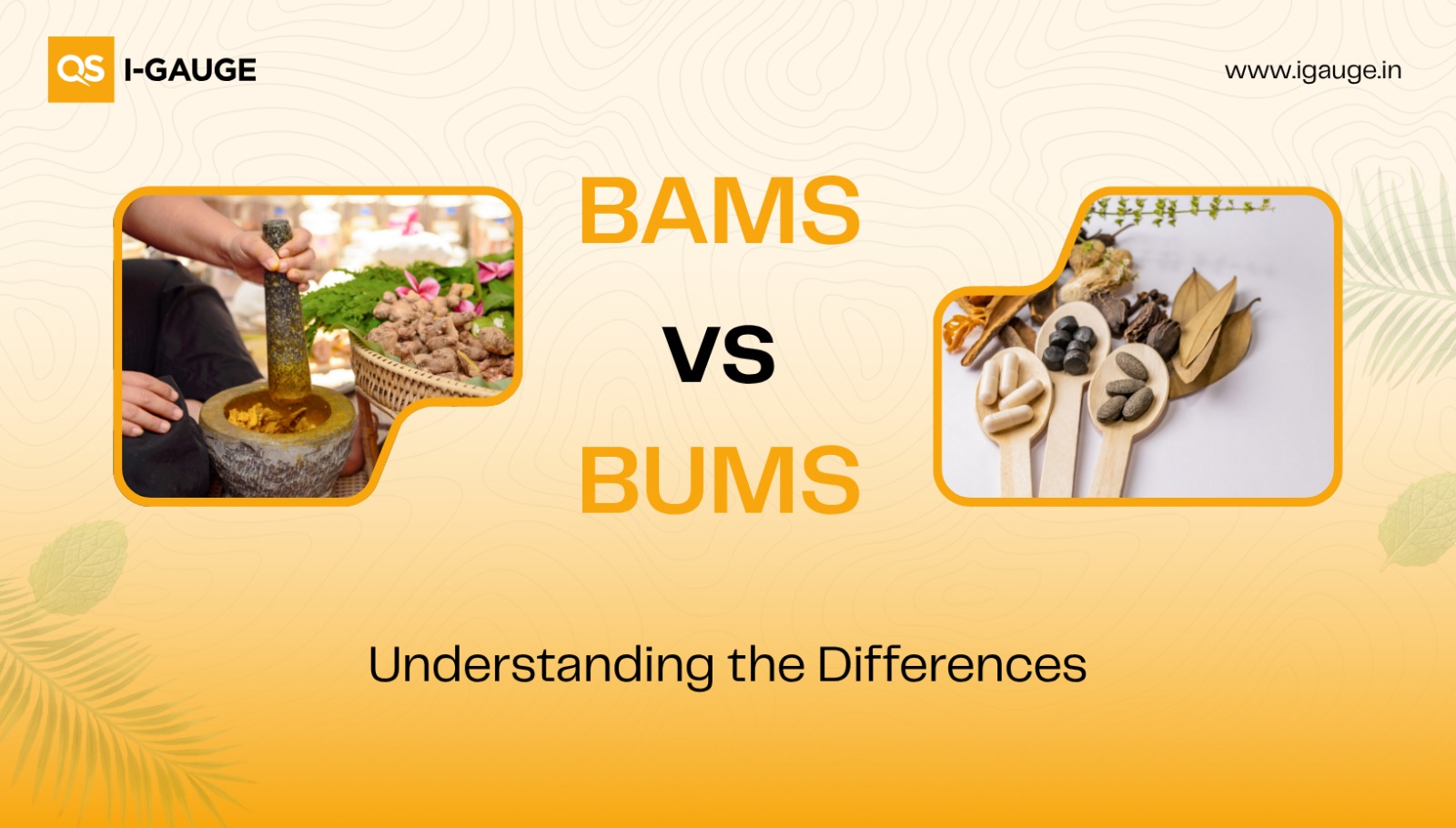
BAMS is a medical degree in Ayurveda, and BUMS is a medical degree in Unani medicine. Choosing between the two involves understanding the core principles and choosing a system that you are passionate about studying and practicing.
Understanding the differences
1. Course details
BAMS is the Bachelor of Ayurvedic Medicine and Surgery, considered one of the oldest holistic systems of medicine. The Ayurvedic principle of built on balancing the three doshas in the body, i.e., Vata, Pitta, and Kapha. Students study this philosophy in detail together with classical Sanskrit texts, medicinal plants, and clinical practice.
It is an undergraduate degree in Ayurveda. The curriculum includes –
· Ayurvedic philosophy and fundamentals
· Sanskrit and classical texts, with Samhitas
· Rachna Sharir (Anatomy) and Kriya Sharir (Physiology)
· Dravyaguna (medicinal plants and pharmacology)
· Rasashastra and Bhaishajya Kalpana (Ayurvedic pharmaceutics)
· Roga Nidan (pathology and diagnosis)
· Kayachikitsa (Ayurvedic internal medicine)
· Shalya Tantra and Shalakya Tantra (Ayurvedic surgery)
· Panchakarma, yoga and preventive healthcare
BUMS is the Bachelor of Unani Medicine and Surgery, having its roots in Greco-Arabic medicine systems. The philosophy is based on balancing 4 humors (Akhlat), i.e., blood, phlegm, yellow bile, and black bile. Along with this, it also considers the interaction of elements, temperament, organs, vital spirits, faculties, and bodily functions.
It is an undergraduate degree in Unani medicine. The curriculum includes –
· Kulliyat Umoore Tabiya (basic principles of Unani medicine)
· Tashreehul Badan (Anatomy) and Manafeul Aza (Physiology)
· Ilmul Advia (Pharmacology)
· Mahiyatul Amraz (Pathology)
· Tahaffuzi wa Samaji Tib (preventive and social medicine)
· Moalajat (medicine and treatment)
· Ilme Tibbe Qanoon wa Ilmul Samoom (medical jurisprudence and toxicology)
· Urdu, Arabic and Mantiq wa Falsafa (logic and philosophy)
The admission process is same for both the courses. They are regulated by NCISM and entered through NEET-UG. Counselling for All India Quota AYUSH seats is done by the AYUSH Admissions Central Counselling Committee (AACCC).
Read more about BAMS course here - https://www.igauge.in/blogs/bams-course-details-eligibility-subjects-career-paths-jobs-opportunities-and-salary
Read more about BUMS course here – https://www.igauge.in/blogs/bachelor-of-unani-medicine-and-surgery-course-details-and-career-scope
2. Career scope
After BAMS
· Ayurvedic clinical practice
· Ayurvedic hospitals and dispensaries
· Panchakarma and wellness centres
· Ayurvedic pharmaceutical companies
· Drug quality, safety and product development
· Research in Ayurveda and medicinal plants
· Public health and wellness programmes
· Medical writing and healthcare education
· MD/MS Ayurveda specialisations
After BUMS
· Unani clinical practice
· Unani hospitals and dispensaries
· Unani pharmaceutical companies
· Drug quality and safety monitoring
· Research in Unani medicine and medicinal plants
· Public health programmes
· Medical writing and healthcare education
· MD in Unani specialisations
Conclusion
For those interested in Ayurvedic classical texts and philosophies, BAMS is the best option; and for those drawn to Greco-Arabic theory, humoral theory, temperament-based analysis, and its Arabic, Urdu, and Persian terminologies, BUMS is the best option. Both systems are respected in India; the choice depends on the individual’s interest and on researching both systems before making a decision.
For personalised guidance and more information, write to us at marketing@igauge.in and our team will get in touch with you.
Disclaimer
The blog is curated by referring to various credible sources and does not necessarily reflect the opinions or positions of QS I-GAUGE. The information provided is for general informational purposes only, readers are advised to conduct their own research and seek professional advice before making any decisions.






.svg)

.svg)
.svg)