


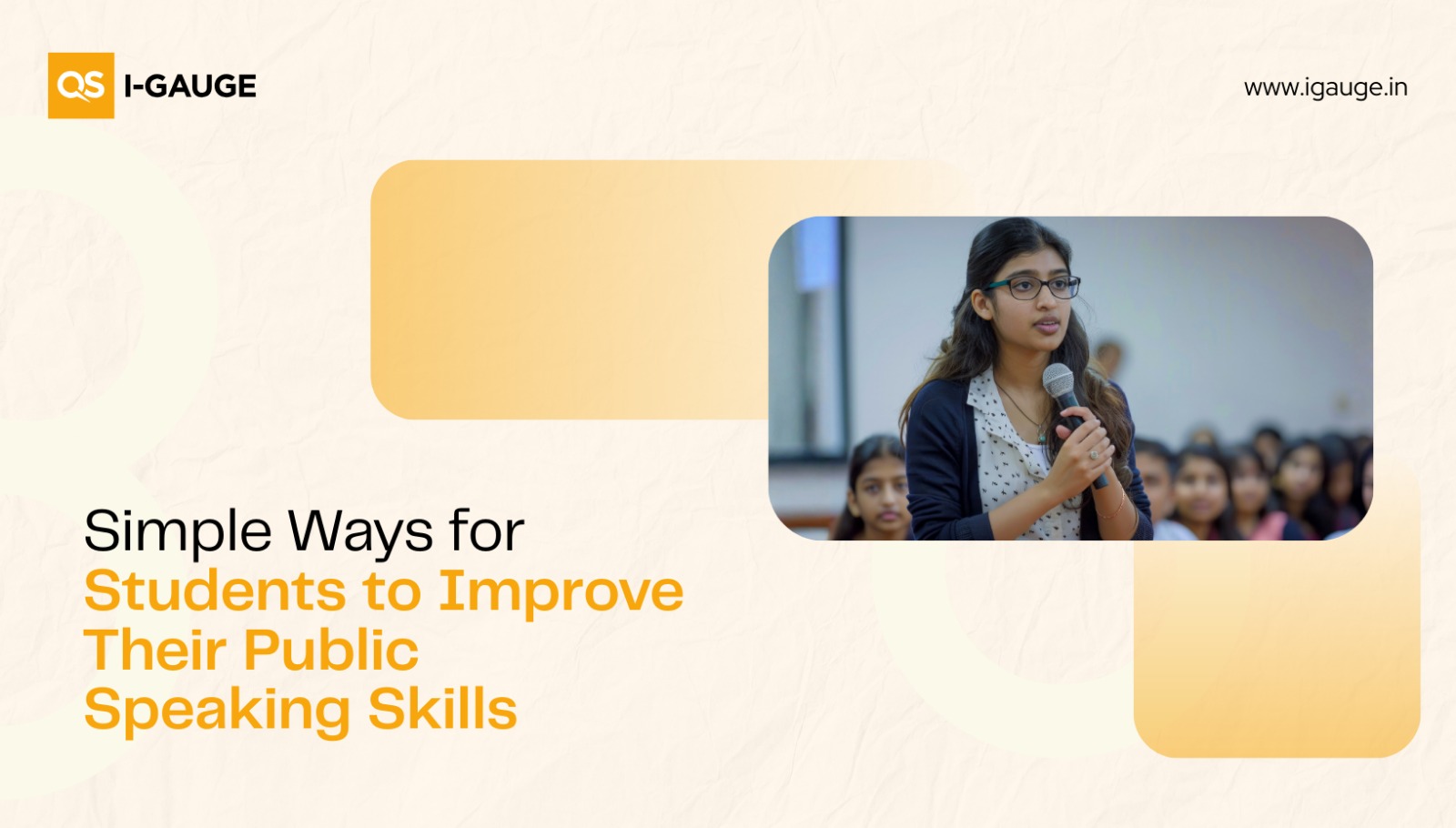
Public speaking is a communication skill that is considered crucial for students in the current age. It refers to clarity in thought flow and the confident delivery of the message to the audience. The purpose of the speech could be educational or informational, but what matters is how a student can think with clarity, overcome the feelings of anxiety and fear to face the audience, feel confident about themselves and their points, and have a presence of mind to face the audience's questions with grit and knowledge.
In the age of AI, there are only a few things that humans do that AI can’t! Things such as critical thinking, good communication skills, logical reasoning, problem solving, and facing the world with confidence are something only humans can do, and all these things put together constitute public speaking. While it is easier said than done to speak in public, it takes continuous practice and a mindset shift to face the public confidently.
Here are some ways students can develop this skill efficiently –
1. Practice is the key – This involves a few techniques.
First and foremost, practice to tell the mind that you are capable and believe in yourself.
a. Stand in front of the mirror and practice speeches. Start with small, simple topics. There will be fumbles, mistakes, lack of clarity, and communication issues at the start. But with practice, this will slowly start to transform for the better.
b. Record your speeches. Video recording helps you monitor and point out your mistakes. You can check your body language, pronunciation, and track your flow of thoughts. You can also check your pitch, voice projection, and pace, and make adjustments accordingly.
c. Practice in front of people who don’t judge you, such as your parents, siblings, friends, grandparents, etc. Ask them to pick a topic, and you can spend a few minutes preparing for it and then deliver what you think about it. You will see that you would have gotten better within a matter of a few months.
d. Practice mindfulness. Practice deep breathing and talk to yourself positively before, while practicing, and through the actual speech.
2. Read about the topics – A right understanding of a topic is crucial to get the concepts and facts right. Confidence builds with knowledge. When you know that the points that you have gathered about a topic are from the right source, you have got the concept and the core of the theme right, you will obviously be more prepared to think systematically and share your thoughts. Once you get a hang of speaking in front of people, you will understand how to make amends to your speeches – you can include quotes by eminent personalities, quote personal examples, real-life case studies, include humour to make it more interesting, and take the route of emotional storytelling to captivate the audiences.
But it is important to refer to authentic resources – take the help of your teachers, parents, seniors, and older siblings.
3. Be receptive to feedback – When you present your speech to your mentors, seniors, teachers, or even parents, there might be certain feedback about your ways of delivery, your research methods, at times, maybe even a showcase of overconfidence to cover up for the lack of subject understanding, or such other responses. When you consider these points to build your techniques, you will become better at the craft. If you have a closed mind and are not open to criticism, growth stops.
4. Practice for different set-ups - Practicing in front of a few people and projecting your speech for a larger audience in a bigger space can be two totally different things. It again boils down to how well you understand the topic and how well you have trained yourself to face the audience. It also matters how often you attend such shows and how familiar you are with such environments.
While on the stage, avoid fiddling with objects and keeping your hands inside your pockets, as these might come across as a lack of confidence. You can carry small notes as trigger points, but avoid reading from a script. Keep the notes structured, organised, and handy. Avoid rummaging for the sheet between the speech.
Case study
A few 9th-grade students at Kendriya Vidyalaya school in India were put under 6 weeks of behaviour modification techniques. These were students with high public speaking anxiety. In these 6 weeks, students were allowed to participate in group dialogues, voice and breathing exercises, talking to support groups (peers) with similar issues, and they were deliberately allowed to fail to reduce the fear of failure. After the exercise, it was seen that the students exhibited reduced anxiety and fear, and better self-esteem.
In another experiment, a few university students with moderate to high anxiety were made to undergo a 5-hour Corp-Oral (specialised and evidence-based) program. It focused on body awareness, gesture monitoring and betterment, visualisation, and anxiety redirection. After the program, they noticed that students exhibited reduced anxiety during speeches, heart rate dropped by 4.7%, there was better emotional regulation, and sensorimotor integration.
Conclusion
Public speaking as a skill is not confined to building presentations or winning debates; it is a skill needed for students to communicate effectively, express ideas clearly, and lead confidently in the future.
For personalised guidance and more information, write to us at marketing@igauge.in and our team will get in touch with you.
Disclaimer
The blog is curated by referring to various credible sources and does not necessarily reflect the opinions or positions of QS I-GAUGE. The information provided is for general informational purposes only, readers are advised to conduct their own research and seek professional advice before making any decisions.



.png)



.svg)

.svg)
.svg)